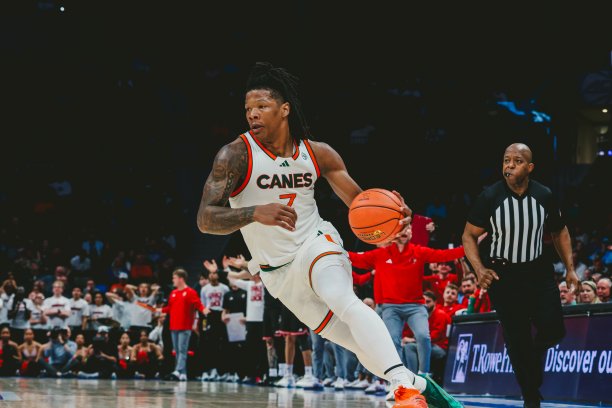
Miami does not need one perfect starting five to make Shelton Henderson harder to guard. Jai Lucas needs several lineups that change where the second defender can come from.
Henderson already proved he can finish the first action. His Miami biography lists 13.7 points per game on 56.7% shooting as a freshman, the third-best field-goal rate among first-year Division I players. He started all 35 games and reached 18 points in Miami’s NCAA Tournament loss to Purdue.
The next step is making opponents pay for loading the lane. Miami’s 2026-27 roster gives Lucas enough shooting, playmaking and size to build different answers. These three groups are combinations to test, not predictions about the opening-night starters.
The shooting group: Acaden Lewis, Brent Bland, Nick Dorn, Henderson and Somto Cyril. Lewis supplies the organizer, while Bland and Dorn force defenders to stay attached beyond the arc. Bland made 79 3-pointers at a 36.9% rate for Saint Peter’s, and Dorn shot 38% from deep at Indiana.
The extra spacing lets Henderson attack a moving defense instead of three bodies waiting at the nail. Cyril does not stretch the floor, but his vertical threat gives the weak-side big a choice: step toward Henderson and concede a lob, or stay home and let Miami’s forward reach the rim. The defensive question is whether the group can keep Dorn out of difficult matchups.
The quick-decision group: Lewis, Dante Allen, Bland, Henderson and DeSean Goode. This version removes a traditional center and asks Goode to screen, dive and own the offensive glass. Lewis set Villanova freshman records with 176 assists and 63 steals, as his Miami profile shows. He can get Henderson the ball before a defense completes its shell.
Goode gives the smaller group real rebounding. He collected 287 boards, including 104 on offense, at Robert Morris last season, according to Miami’s published record. Henderson can screen for Lewis, catch on a short roll or attack a closeout while Goode occupies the defender most likely to help at the rim.
The pressure group: Lewis, Allen, Henderson, Goode and Cyril. This is the least comfortable shooting lineup and potentially the best way to create offense without calling a half-court play. Cyril averaged 2.2 blocks at Georgia, led the SEC in that category and finished with 83 dunks, as his Miami biography details.
Stops can turn Henderson into a transition playmaker before opponents place two defenders in his path. Lewis pressures the ball, Cyril protects the rim, and Goode finishes possessions on the glass. Lucas can use the group against teams that struggle to shoot, then replace one big with Dorn or Bland when the floor becomes too crowded.
CaneSport’s review of Miami’s offseason emphasized the return of Henderson and a portal class ranked No. 2 by On3. The value of that depth is not simply having more recognizable players. It is allowing Lucas to solve a game without asking Henderson to beat the same coverage for 40 minutes.
Henderson remains the common piece because his combination of strength, touch and passing can connect each style. The best Miami lineup may change by opponent or even by timeout. If Lucas keeps changing the source of help, defenses will have a much harder time turning Henderson’s second season into a predictable scouting report.
Comments