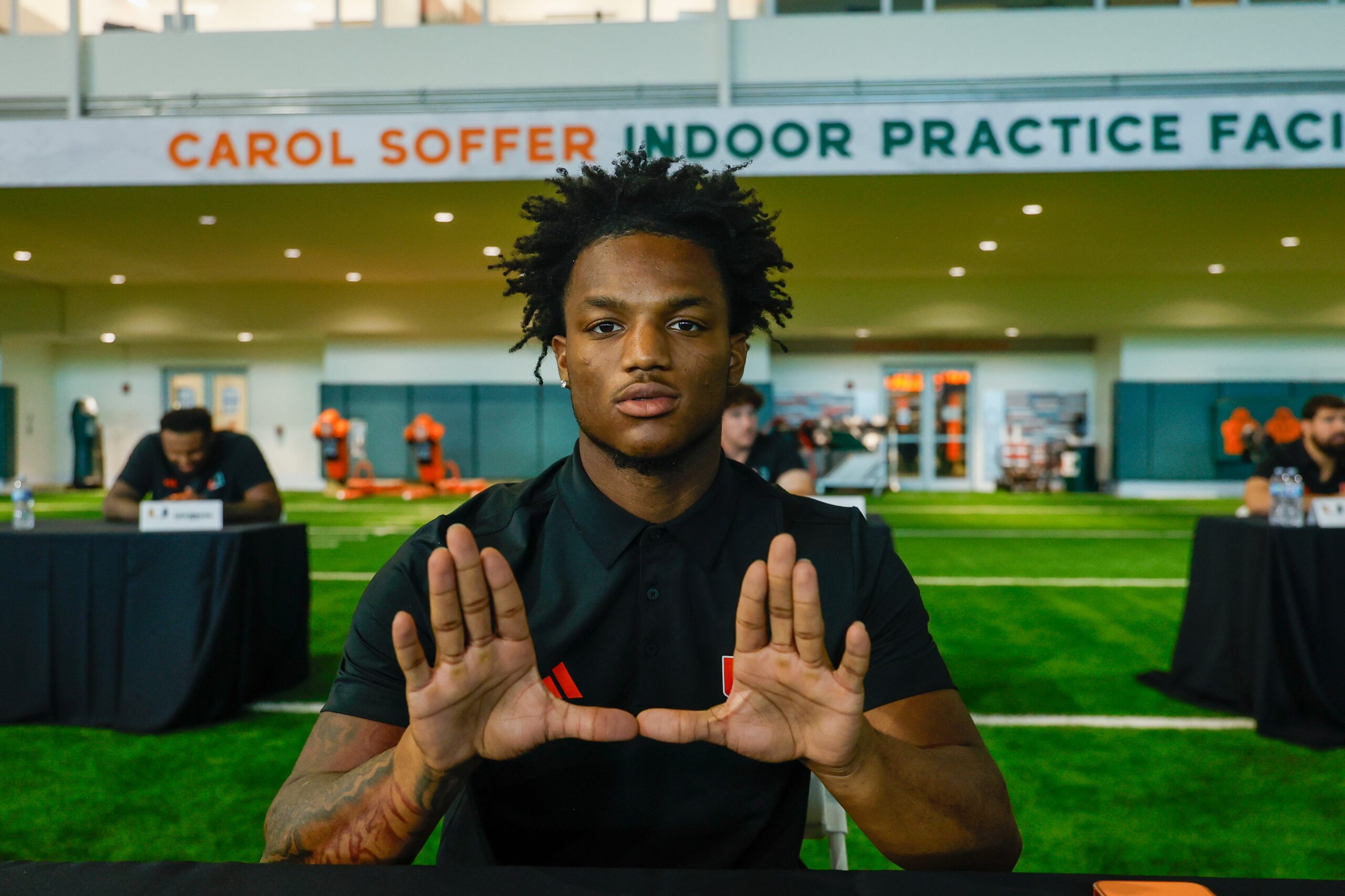
Somourian Wingo’s fastest path to meaningful snaps in Miami’s crowded receiver room starts with everything he can do when Darian Mensah does not throw him the ball.
EJ Holland of CaneSport reported Wednesday that the freshman is fighting for playing time in Miami’s deepest position group. Wingo has embraced coaching, studied Malachi Toney’s professional approach and built a relationship with Mensah while preparing to contribute wherever the Hurricanes need him.
The last part should define his early plan. Toney enters the season as the established star, and Cooper Barkate, Joshua Moore, Daylyn Upshaw and other receivers give Shannon Dawson experienced options. A freshman can wait for injuries and target distribution to create an opening, or he can make himself useful before the depth chart needs another featured pass catcher.
Blocking is the first separator. Miami wants Mark Fletcher Jr. to punish light boxes, and perimeter runs only become explosive when receivers handle corners and safeties. Wingo does not need to flatten every defender. He needs correct leverage, active feet and the willingness to finish long enough for Fletcher or Malachi Toney to clear the edge.
Those snaps can become a scouting advantage. If opponents see Wingo and assume Miami has inserted a freshman only to run, Dawson can use the same alignment for a glance route, play-action shot or motion touch. A receiver earns that opportunity by making the run look credible first. The work without the ball creates better chances with it.
Special teams offer the second route. Wingo’s official Miami biography lists a senior high school season with 46 catches, 847 yards and 13 receiving touchdowns after he topped 1,000 yards as a junior. His production proves he can handle the ball. His size, speed and open-field experience can also translate to coverage, return and blocking units.
A freshman who earns a game-day place on special teams becomes easier to use for six or eight offensive snaps. The staff does not have to activate a receiver for a narrow role, and Wingo can build comfort with crowd noise, sideline communication and live contact before the passing game depends on him.
Assignment reliability is the third piece. The State of The U receiver preview described a room with established production and real competition around Toney. In that setting, a missed split or wrong route depth can be more damaging than one spectacular practice catch is helpful. Mensah needs to know where a receiver will be when pressure changes the timing.
Wingo can make his progress visible by mastering multiple alignments, recognizing coverage rotations and avoiding mental substitutions. Coaches trust the player who lets the offense call its full menu. Once that trust exists, targets become a result of the work instead of the only measurement of it.
None of this lowers Wingo’s receiving ceiling. He was a national recruit with enough high school production to demand attention, and Miami should develop him as a future playmaker. The practical question is how he helps a contender now without forcing the offense to take proven players off the field.
The answer is to win the snaps nobody celebrates in August. Block the edge, run hard when the ball goes elsewhere, contribute on special teams and arrive in the exact place Mensah expects. A crowded receiver room can keep a freshman from collecting early targets. It cannot keep a complete football player off the field forever.
Comments