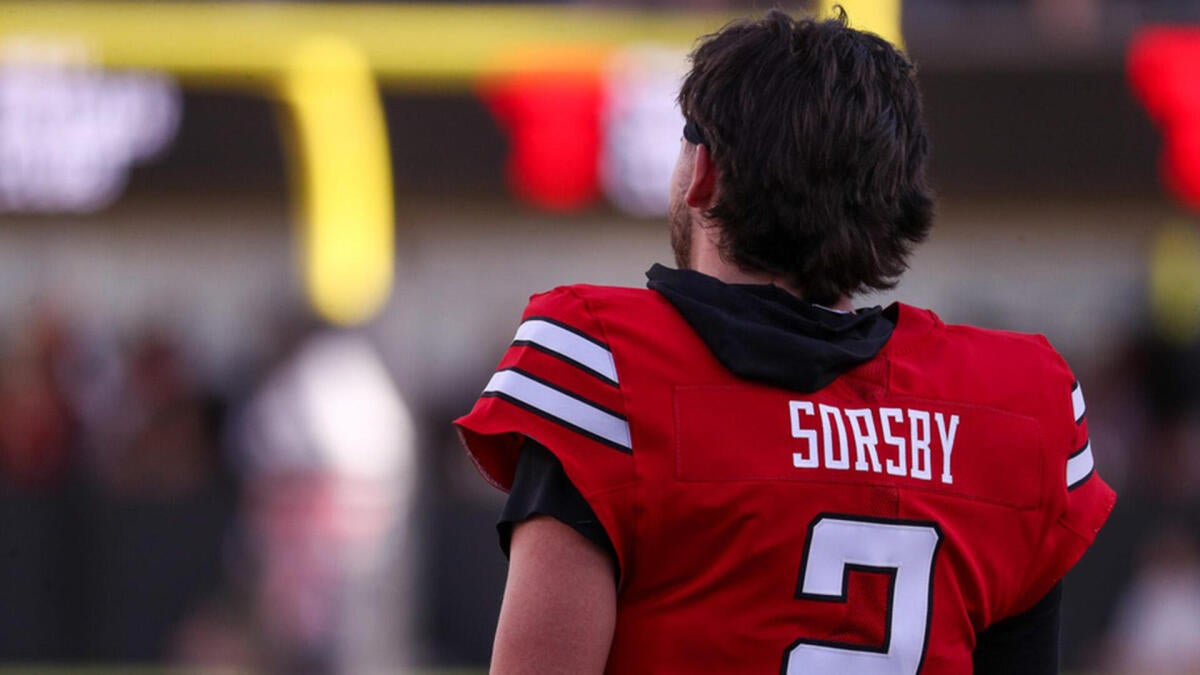
The NFL’s decision on Brendan Sorsby is a college football story every major program should pay some attention.
The NFL decided not to conduct a supplemental draft in July 2026, meaning Sorsby will have to wait until the April 2027 NFL Draft to enter the league, according to Mike Florio of Pro Football Talk. The league believed there was not enough time to fully investigate Sorsby’s gambling activity.
The message to quarterbacks with NFL traits and college eligibility complications is blunt: timing and off-field risk can keep the league from letting you walk through the door.
Sorsby had become the most interesting supplemental draft case in years because the talent evaluation was real. CBS Sports spoke with six NFL front-office and personnel sources before the NFL’s decision, and all six viewed Sorsby as a quarterback who likely would have been drafted if the supplemental process moved forward. Four projected him in the fourth round or later, while two projected him in the third round, according to Matt Zenitz of CBS Sports.
Multiple sources viewed Sorsby, who started at Cincinnati before transferring to Texas Tech, as better than every quarterback from the 2026 NFL Draft other than Fernando Mendoza and Ty Simpson. The talent was not dismissed, and it probably wasn’t a factor.
The gambling piece is why this matters beyond one player. Sorsby admitted to placing at least $90,000 in bets while in college, including at least 40 on Indiana football games while he was on the Hoosiers’ roster. Yardbarker’s Zac Wassink wrote that Sorsby’s agent, Ron Slavin, said Sorsby never bet on games he played in and entered a residential treatment program for a gambling addiction.
The NFL encouraged Sorsby to prepare for possible entry through the 2027 NFL Draft. Sorsby’s counsel, Jeffrey Kessler, planned to challenge the NFL’s decision through the NFLPA after arguing it violated the collective bargaining agreement.
The quarterback market now lives at the intersection of NIL, transfer rules, eligibility fights, gambling policy and NFL timing. A staff cannot just ask whether a quarterback has an arm. It has to ask whether every part of the path is clean enough to survive scrutiny with all the uncertainty in today’s college game.
Miami has lived through enough quarterback volatility to know how one decision can reshape a season. A high-upside transfer can change a program. A high-upside transfer with unresolved eligibility or conduct questions can also leave a program scrambling if the exit route disappears. Sorsby thought the supplemental draft might be an option after his college path became unstable. The NFL just made that option disappear.
Comments