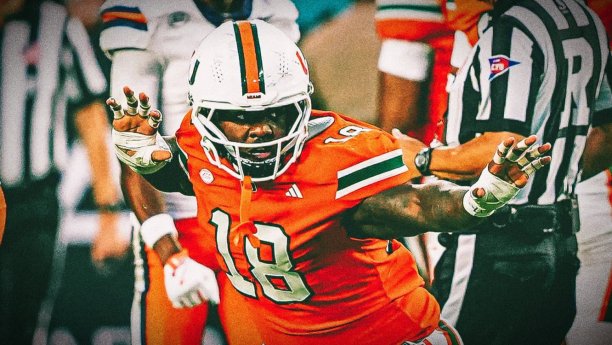
Armondo Blount says the largest change in his game is happening before the snap. The Miami defensive lineman described a broader football IQ and a deeper commitment to film study Saturday as he prepares for a larger role on a front replacing proven edge production.
Kamdyn Burton of CanesInSight reported that Blount now understands how to break down offensive tendencies instead of relying only on his physical ability. His progress can decide whether he becomes an occasional flash player or a defender Miami trusts across every down and distance.
Film study gives an edge defender a head start that raw speed cannot replace. An offensive tackle’s stance can suggest pass or run. A tight end’s alignment can reveal whether he plans to release, block down or help on the edge. Backfield depth can narrow the likely path of a run. None of those clues guarantees the play, but processing them quickly lets Blount attack with a plan.
The Hurricanes need that discipline because opponents will test the new front with misdirection. Rueben Bain Jr. and Akheem Mesidor commanded attention last season. Their presence allowed younger defenders to play within a clearer structure. Blount now has to help create that structure while offenses use screens, counters and read concepts to punish an edge player who chases the first movement he sees.
Blount also praised the work ethic of Miami’s younger offensive linemen. The competition matters for both groups. A defensive lineman develops better counters when blockers force him to move beyond his first technique. An offensive lineman improves when the rusher across from him can win with power, speed or recognition. August repetitions can become a shared laboratory rather than a simple daily scorecard.
Miami’s Saturday camp report placed Blount alongside Justin Scott, Marquise Lightfoot and Chase Smith as players discussing development and leadership. The defensive line’s message was consistent: younger talent has to absorb standards from veterans and then apply them without waiting for game day.
For Blount, the next measure will be the quality of his early-down work. Sacks draw attention, but a dependable edge player must set the boundary against the run, squeeze a pulling blocker and avoid opening escape lanes for mobile quarterbacks. Better recognition should put him in position to make those less glamorous plays.
It also can improve his pass rush. Identifying protection allows a defender to choose a counter before contact. If the tackle expects outside speed, Blount can convert to power. If the protection slides away, he can attack the shortest path before help arrives. The goal is not to guess. It is to reduce hesitation by preparing for the most likely answer.
Miami already knew Blount had the body and movement skills to become an impact defender. His Saturday comments supplied a more important update: he is building the mental process needed to use those tools consistently. The Hurricanes do not need him to imitate the stars who came before him. They need him to recognize the offense, control his assignment and make the next generation of Miami’s front difficult to predict.
Comments