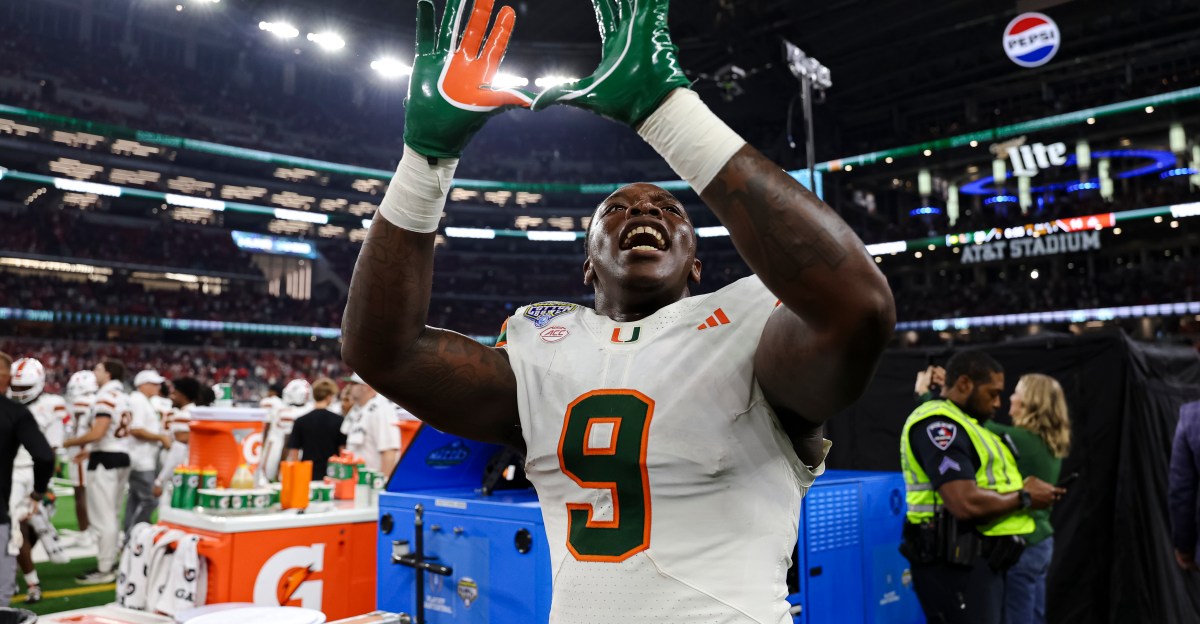
Elija Lofton’s pass protection should determine how far Miami can take its two-tight-end offense, even though his receiving ability will draw more attention.
Jake Marcus of State of The U summarized Lofton’s broad role and noted that he has played 28 college games with five touchdown catches. The same preview cited a stronger 2025 pass-blocking grade than run-blocking grade, an important clue for an offense breaking in a new quarterback and a rebuilt line.
Twelve personnel works best when the formation does not announce the play. If one tight end is only a receiver and the other is only a blocker, the defense can match each player’s job before the snap. Lofton gives Shannon Dawson a chance to keep both possibilities alive from the same alignment.
Miami can place Lofton next to a tackle, in the slot or across the formation as a motion player. Each location changes the defense’s picture. The value multiplies if he can chip an edge rusher, stay in against pressure or release late after the defense commits extra help to the rush.
Pass protection is not simply standing next to an offensive lineman. Lofton must identify the dangerous rusher, strike without losing balance and understand when a defender is looping inside. A late recognition can ruin a play even when the initial block looks strong. Consistent communication with the tackle and running back matters as much as physical contact.
Darian Mensah would gain a cleaner answer against uncertain pressure. Miami could show a heavy run look, keep Lofton in when the defense attacks and send fewer receivers into more favorable matchups. On the next snap, Lofton could release up the seam from the same look. The defense would have to wait for evidence instead of reacting to a substitution.
The package can help the running game without making Lofton a traditional in-line mauler on every snap. Motion can improve his angle. Split-flow action can ask him to block a defender who is moving laterally instead of charging straight ahead. A credible pass-protection role prevents opponents from treating every backfield motion as a run key.
Miami’s roster gives the staff different body types to use at tight end, but Lofton’s versatility makes him the hinge. A second tight end can handle the most favorable assignment while Lofton moves to the location that creates uncertainty. The structure becomes adaptable instead of merely bigger.
Receiving production will still matter. Lofton can punish linebackers after a protection look and become a quick outlet when Mensah sees pressure. His routes become more effective because defenders cannot release him immediately if he has already shown a willingness to block.
Miami should judge the package by how many answers it preserves after the snap. Lofton’s pass protection can keep the quarterback clean, disguise the release pattern and prevent personnel from revealing intent. If he becomes trustworthy in that job, 12 personnel will be more than a short-yardage formation. It can become the Hurricanes’ best way to make a rebuilt offense look the same while doing something different.
Comments