Damon Wilson II reduced his next step to an outside hand and violent leverage. The technique sounds small, but it can decide whether Miami’s new edge rotation creates a negative play or opens an escape lane.
Wilson said Monday that he wants to improve his two-to-one leverage, keep his outside hand free and become more forceful at the point of attack. He also described Jason Taylor as a coach who corrects every rep and treats the small details as important to Trinton Breeze of CanesInSight.
The outside hand controls more than one matchup. An edge defender who allows a tackle or tight end to capture his outside shoulder can be widened out of the run fit. The running back gains a clean lane, or the quarterback escapes a pass rush that looked successful for its first two seconds.
Miami needs Wilson to close that route while still threatening the pocket. His nine sacks at Missouri last season make him the proven newcomer in a group asking Marquise Lightfoot and Armondo Blount to expand their roles. Sack production becomes less valuable if aggressive rushes trade third-and-long for a quarterback scramble.
The edge group will handle most of Miami’s work against both run and pass, Jordan McPherson of the Miami Herald wrote Monday. McPherson also detailed how Blount and Lightfoot learned behind first-round picks Rueben Bain Jr. and Akheem Mesidor. Wilson adds a different program background and a year of SEC production to that succession.
Taylor can use the three rushers in complementary ways. Lightfoot’s speed forces tackles to respect the corner, Blount can bring power from heavier alignments and Wilson can attack with a developed pass-rush plan. Every package still needs one defender responsible for keeping the ball inside.
Wilson’s checklist is especially important against Stanford. A new offensive staff can use movement, option looks and condensed formations to test whether Miami chases the first action. The edge has to recognize when to squeeze, when to stay square and when the quarterback has become the runner.
Violence cannot become a substitute for control. Wilson’s reference to being the most violent player on the field describes finish and intent. The useful version places that force through the proper shoulder, separates from the blocker and leaves the defender balanced enough to tackle.
Monday’s official Miami camp report also included Wilson’s praise for the intelligence of offensive tackle Samson Okunlola. Their daily matchup should expose whether Wilson’s hands arrive in the right place. Okunlola knows protections and can punish a rusher who declares his path too early.
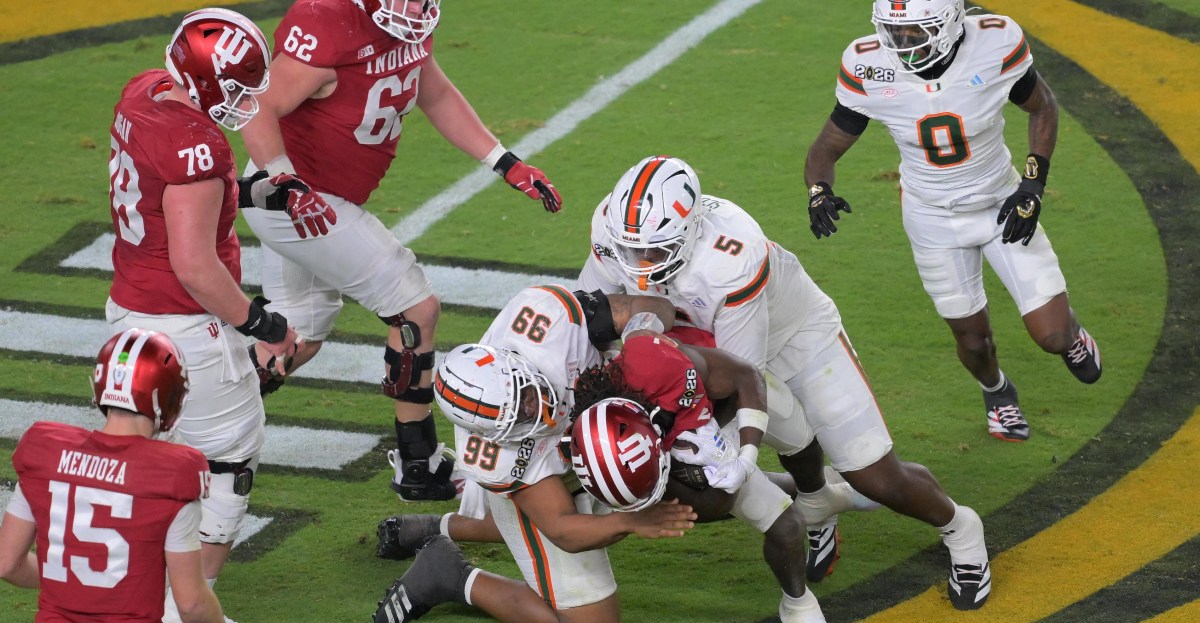
The interior helps complete the picture. Ahmad Moten and Justin Scott can collapse space so a quarterback cannot step away from the edge. The featured State of The U photograph shows Wilson and Moten converging on an Indiana ball carrier, the kind of connected finish Miami needs from its rebuilt front.
Wilson does not have to replace Bain or Mesidor by himself. He has to make his own pressure trustworthy. A free outside hand keeps the run inside, protects the rush lane and lets the next defender finish. Miami’s front can be aggressive because the edge remained disciplined, not despite it.
Comments