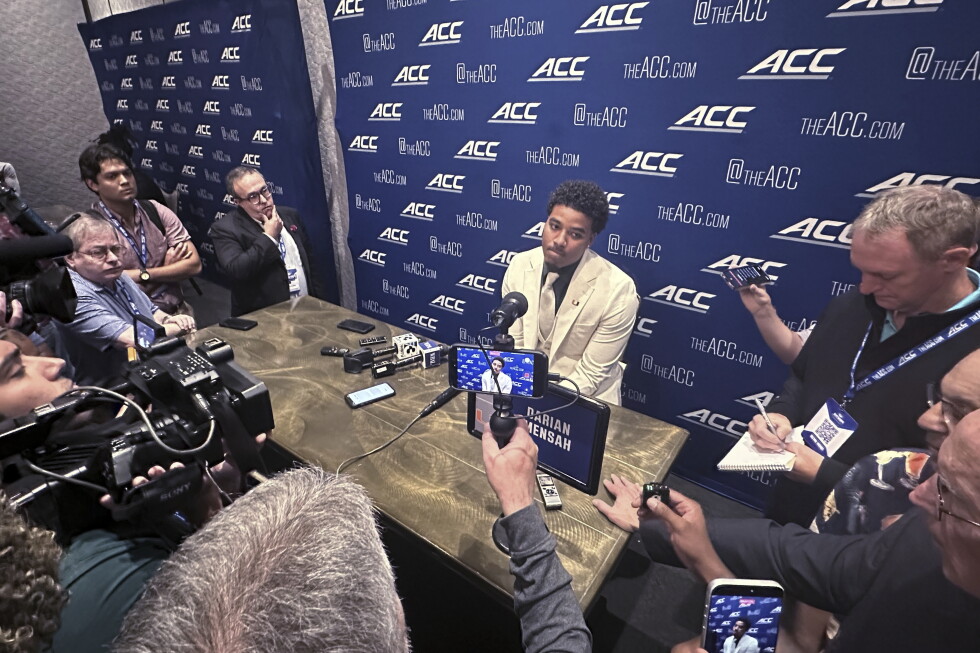
Miami should make Darian Mensah’s legs a selective red-zone weapon instead of trying to solve every compressed-field problem with a larger passing menu.
Aaron Beard of The Associated Press detailed the expectations surrounding Mensah after he led Duke to the 2025 ACC championship. Preseason voters made him the league’s player of the year, an honor rooted largely in his passing production. Miami can make that arm more dangerous by forcing defenses to account for one additional runner near the goal line.
The red zone changes the geometry of offense. Safeties have less grass to defend, throwing windows close faster and edge defenders can attack without fearing a deep completion behind them. Adding another elaborate route combination does not change the math. Making the quarterback a run threat does.
A zone-read keeper, a short draw or a designed rollout with permission to run can force the defense to assign a body to Mensah. Even when he hands the ball off, the unblocked defender must hesitate. The pause can give Miami’s running back the crease that disappears when all 11 defenders attack the same point.
The word selective is essential. Miami does not need to expose its starting quarterback to a dozen designed carries. Two or three high-leverage calls can influence every goal-line snap on film. Mensah should slide or reach the boundary whenever the touchdown is not immediately available, and the staff should avoid using him as a short-yardage battering ram.
His passing résumé already gives the package credibility. Mensah threw for 3,973 yards with 34 touchdowns and six interceptions last season. Defenses cannot sell out against his legs without opening quick throws behind the reaction.
Shannon Dawson can build the package from concepts Miami already carries. A run-pass option can pair an inside run with a glance route. A sprint-out can give Mensah a flat receiver, a back-line target and a path to the pylon. The offense gains three answers without teaching an entirely new formation.
The approach would also help a rebuilt offensive line. Red-zone protection is difficult because rushers reach the quarterback quickly and throwing lanes become crowded. Moving the launch point or reading one edge defender reduces the number of blocks that must be perfect. It turns uncertainty into a defined choice.
Miami should test the calls early in the season rather than hiding all of them for a marquee game. Live repetitions will show how Mensah protects himself, how quickly he makes the give-or-keep decision and which formations create the cleanest numbers. The film can then make later opponents spend practice time on the threat. Each successful keeper would make the next handoff more difficult to diagnose.
A bigger playbook can create the illusion of more answers while slowing the offense. Mensah’s legs offer a simpler solution. Miami can preserve his health, respect his identity as a passer and still make every defender account for all 11 offensive players. Near the goal line, one extra hesitation may be worth more than 10 extra plays.
Comments