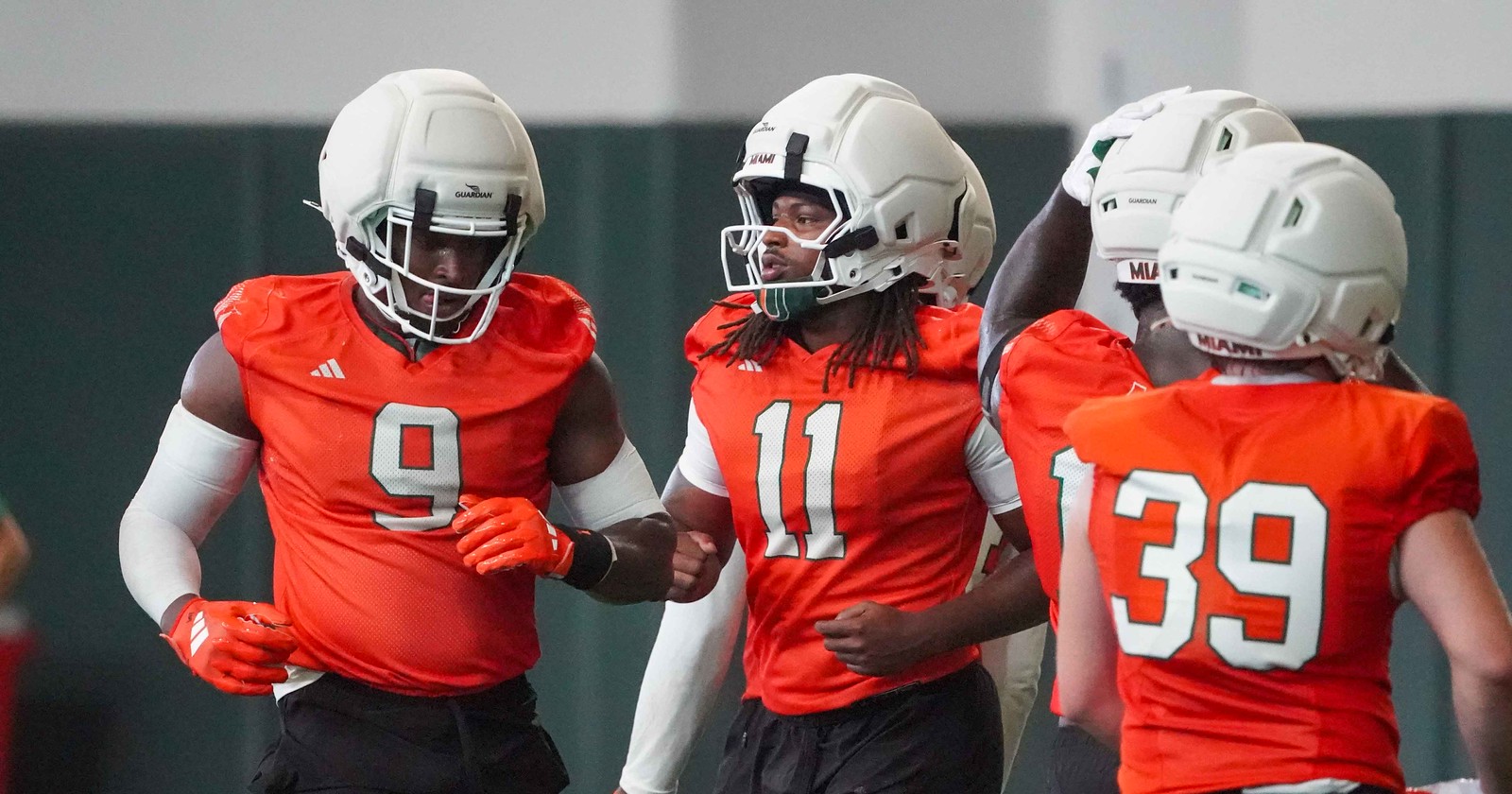
Miami opened 2026 fall camp Tuesday morning, beginning the monthlong process of turning a highly regarded roster into the team that will face Stanford on Sept. 4. Mario Cristobal placed leadership, daily competition and physical preparation at the center of the first practice.
The Hurricanes’ account of the opening session highlighted veteran voices such as Mark Fletcher Jr. and Mohamed Toure. Both players have experienced college seasons long enough to know that August enthusiasm matters only when it survives repetition, fatigue and correction.
Fletcher returns as the obvious center of the running game after rushing for 1,192 yards and 12 touchdowns last season. His camp is not only about protecting a starting job. Miami needs him to set the standard for pass protection, ball security and practice tempo while Jordan Lyle, Charmar Brown and Girard Pringle Jr. compete for work behind him.
Toure brings a similar responsibility to a defense replacing major production up front. The linebacker room must connect a rebuilt line to an experienced secondary. Communication before the snap can keep aggressive calls from becoming open lanes, especially as new players learn Corey Hetherman’s terminology.
Quarterback Darian Mensah drew the most predictable attention. The Duke transfer enters as the starter, but the first practice began his real work with Miami’s protections and receiving group. An offseason throwing session can establish timing. Camp adds a pass rush, checks at the line and the consequences of a late decision.
On3’s first-practice observations described Mensah as sharp and noted encouraging work from OJ Frederique, Somourian Wingo, Elija Lofton and Kamal Bonner. Early impressions remain snapshots. They still identify where competition can push the roster beyond the established stars.
The offensive line will receive the longest evaluation. Miami has proven talent at several spots, yet every combination must communicate with Mensah and create the downhill lanes Fletcher uses best. Cristobal’s background makes that position a daily priority. The staff can experiment now before the opener makes every missed assignment expensive.
The secondary has a different challenge. Frederique gives Miami a trusted cover player, while Xavier Lucas, Damari Brown, Bryce Fitzgerald and several newcomers expand the possible packages. Coaches must decide which combinations tackle well enough to stay on the field and which players can handle multiple alignments without slowing the call.
Cristobal’s post-practice comments emphasized the work still ahead. It is the useful frame for a team carrying top-10 expectations. Miami does not need to win August. It needs to leave the month with a clean operation, reliable depth and a clear response when a practice turns difficult.
Special teams will provide another route into the lineup. A reserve who covers a kickoff, protects a punt or handles a return assignment can justify a game-day place before he earns regular offensive or defensive snaps. Those periods will help the staff decide which depth is functional rather than theoretical.
The first session supplied no final depth chart and no guarantee about September. It did start the only process that can answer those questions. Miami has four weeks to make leadership visible, convert competition into depth and prepare a new quarterback to run an offense expected to contend nationally.
Comments