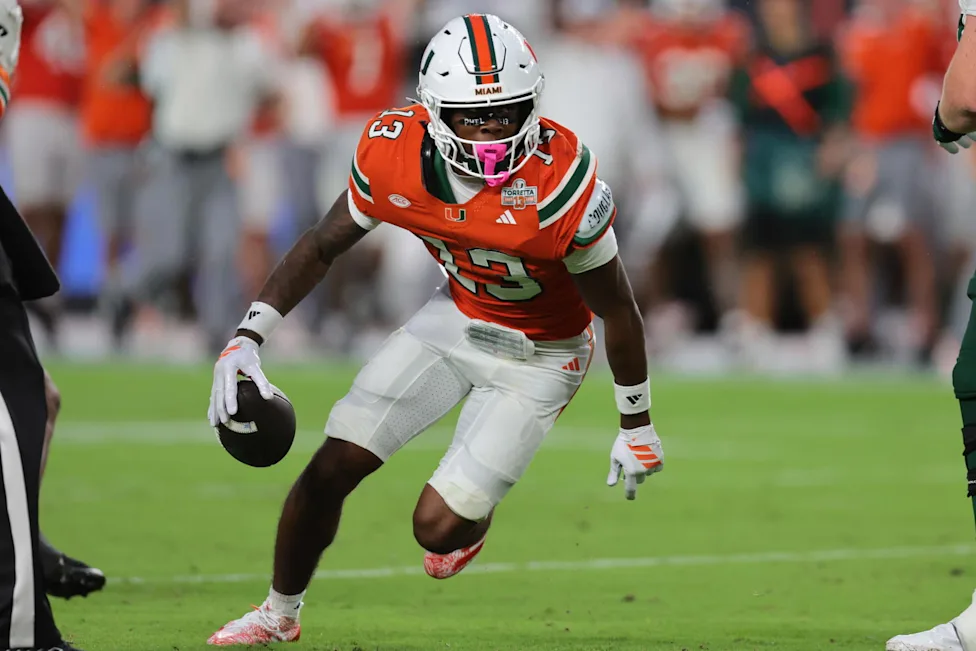
Miami should make Bryce Fitzgerald harder to avoid in 2026. Six interceptions as a freshman gave every opponent a reason to locate him before the snap and send the ball elsewhere. Corey Hetherman’s answer cannot be waiting for quarterbacks to challenge the same alignment. Fitzgerald has to move until the coverage makes them find him again.
Fitzgerald entered the season ranked No. 3 among returning college football safeties by Pro Football Focus, behind Georgia’s KJ Bolden and Alabama’s Bray Hubbard. The recognition follows a freshman season in which Fitzgerald produced six interceptions and repeatedly changed high-leverage games.
His ESPN player card lists him at 6-foot-1 and 190 pounds, a useful frame for multiple secondary jobs. Miami can align him deep, walk him toward the slot or disguise his responsibility until the snap. Each move changes the quarterback’s easiest answer.
Moving Fitzgerald does not mean turning every snap into a trick. A defense that disguises constantly can confuse itself, especially while new combinations settle in. The goal is to create a few packages that preserve clear communication while placing Miami’s best ballhawk near the route concepts an opponent relies on most.
The rest of the secondary makes the idea possible. OJ Frederique Jr., Xavier Lucas, Damari Brown, Omar Thornton and Zechariah Poyser give Miami enough experience to vary assignments. The group has improved through shared film study and constant communication, Poyser explained in Christy Chirinos’ official Miami Athletics camp report.
Fitzgerald’s interceptions also require context. Ball production can swing from season to season because quarterbacks change their choices and tipped passes stop landing in the same place. Miami should not judge his sophomore year by demanding another six. The better question is whether his presence helps the defense dictate where the ball goes.
A robber role could place him beneath a deep safety and let him attack in-breaking routes. A late rotation could make a quarterback believe the middle is open before Fitzgerald closes it. A slot assignment could bring him closer to screens, option routes and the run game. Each option makes avoidance more difficult.
The movement has to remain disciplined. Fitzgerald cannot chase interceptions and abandon leverage. Opponents will use pump fakes and eye manipulation precisely because his freshman tape shows how aggressively he can finish a mistake. The next leap is controlling that instinct without removing the threat that made him special.
Quarterbacks will enter the season knowing Fitzgerald’s number. Miami can treat that attention as a limitation or turn it into a tool. If Hetherman moves him with purpose, the Hurricanes can influence protections and reads before the ball is snapped. Fitzgerald may record fewer interceptions and still become a much larger problem.
Miami can also use Fitzgerald to help a less experienced defender. Aligning him near a freshman corner or a new nickel can simplify that player’s responsibility and discourage the quarterback from attacking the matchup immediately. His reputation then creates value before the ball comes close enough for an interception.
Comments