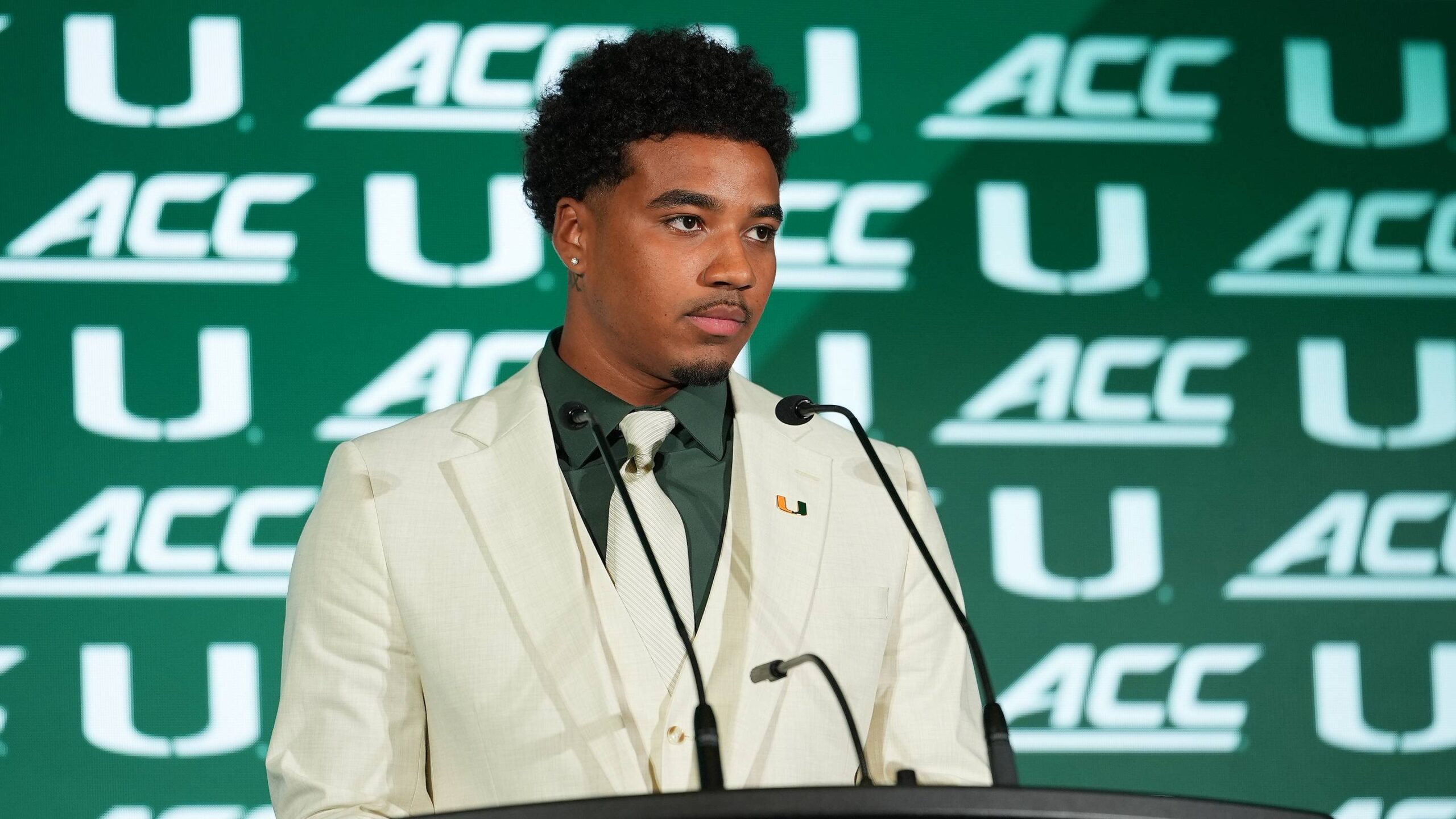
Miami’s reported roster cost belongs in the $40 million range, but the most revealing return on that investment will come from players who are not the most expensive names.
Chris Hummer of CBS Sports polled more than 50 industry sources and placed the Hurricanes well into the $40 million tier. The report identified quarterback Darian Mensah as a major part of the cost and named Damon Wilson II, Malachi Toney and Jackson Cantwell among Miami’s seven-figure players.
This is an analysis of what the estimate should require, not an attempt to present a week-old report as breaking news. Private compensation figures are also estimates rather than an audited public payroll. The useful question is what Miami should receive from a roster assembled at that scale.
Stars provide the obvious answer. Mensah must run a championship-level offense. Toney needs to remain one of the sport’s most dangerous receivers, and Wilson must help replace NFL departures along the edge. High-profile players should perform in the moments that justified the investment.
Depth is the more difficult test. A contender cannot control which offensive lineman turns an ankle, which cornerback misses a series or which running back needs a reduced workload. Spending near the top of the sport should give Miami a credible second answer before an injury creates the question.
This does not mean every backup must carry a star’s price or reputation. It means the roster should avoid a severe drop when coaches rotate. A second-team guard needs to preserve the protection call. A reserve linebacker must align the defense correctly. A fourth receiver must create enough space that opponents cannot ignore him.
Development remains essential even in an expensive model. Money can attract proven transfers and elite recruits, but it cannot teach technique, communication or patience. Miami needs position coaches to turn young talent into reliable snaps so the roster does not require another costly veteran every time a role opens.
The reported total also raises the standard for special teams. Deep rosters contain fast, physical players who may not start on offense or defense. Their value should appear in coverage units, return protection and field position. A highly resourced team cannot treat those snaps as an afterthought.
Miami’s recent results make the expense understandable. Back-to-back 10-win seasons and a run to the national championship game created a reason to push rather than retreat. The program is paying to sustain contention after reaching it, not merely to generate offseason attention.
One season cannot prove every dollar was allocated perfectly. A close loss can occur with a strong roster, and a modestly priced player can outperform a celebrated addition. The evaluation should focus on whether Miami built multiple ways to win when its first plan fails.
A physical opponent may take away the preferred passing game. An injury may force a freshman into the rotation. A long road trip may expose communication problems. The reported investment earns its value when the Hurricanes can change personnel or tactics without changing their championship expectation.
The stars will define Miami’s ceiling, and Mensah will receive the most attention. The second unit can determine whether the floor remains high enough to reach December. For a roster reportedly priced in the $40 million range, usable depth is not a luxury. It is the clearest test of whether Miami bought a team built to last.
Comments